
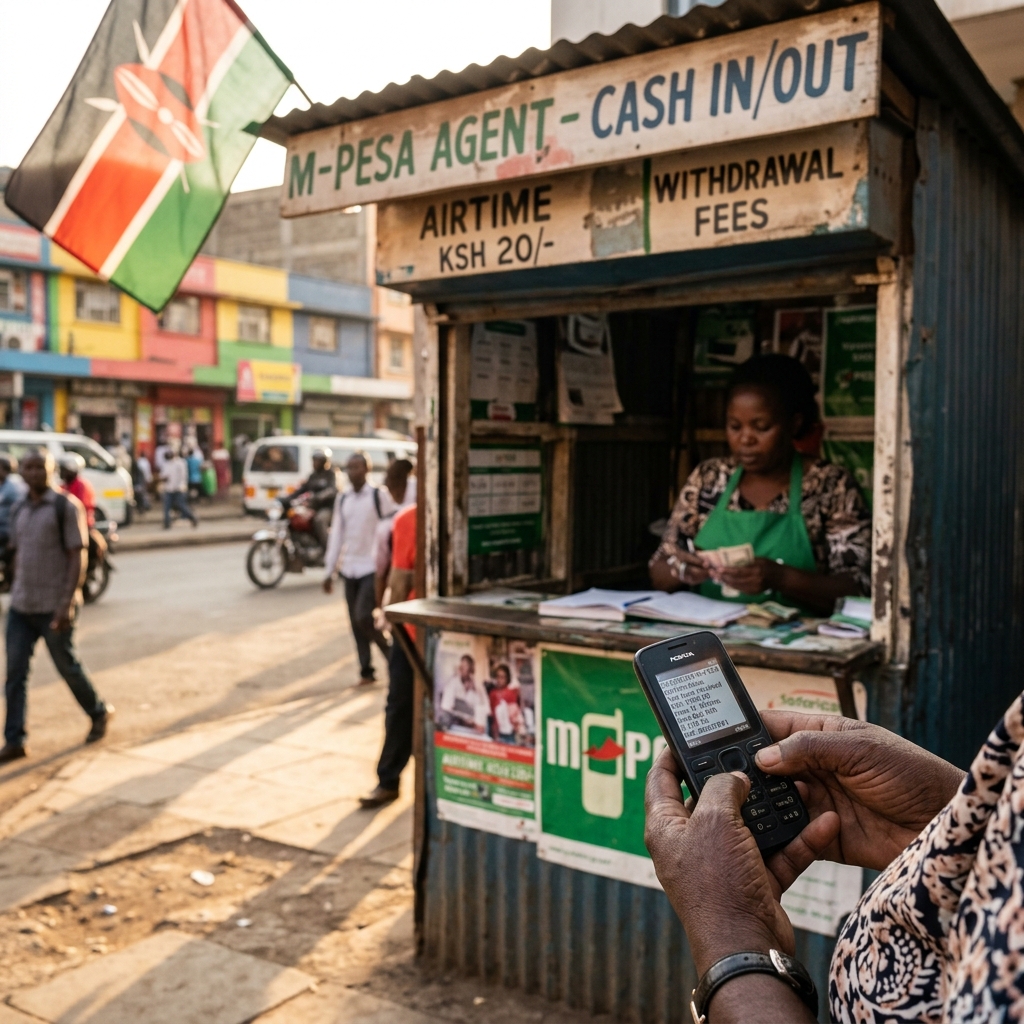
Kenya changed the math on financial inclusion seventeen years ago. In 2007, Safaricom launched M-Pesa, a mobile money service that worked on any phone, required no bank account, and let Kenyans send money as easily as sending a text message. Today, Kenya has more than 53 million mobile money accounts, M-Pesa commands roughly 89% of that market, and the country's mobile money penetration has crossed 100%. That is not a typo. It reflects how deeply the service has embedded itself into daily Kenyan life.
How M-Pesa Works
The mechanics are simple, which is part of why they caught on. A user registers at any of the country's 600,000-plus M-Pesa agents - corner shops, market stalls, petrol stations - with a national ID. After that, the phone number becomes the wallet. Money moves via SMS, no internet required. Recipients get a text notification and can cash out at the nearest agent, or keep the balance to pay bills, buy airtime, or shop at merchants who accept M-Pesa directly. For rural Kenya, where formal banks are sparse, this was not a convenience. It was a different relationship with money altogether.
The Remittance Connection
Remittances sit at the center of that relationship. Kenyans working in Nairobi, Mombasa, or abroad have long sent money home to family in the countryside. Before M-Pesa, that meant cash on a bus, a trusted courier, or an expensive wire service with long delays. Now it happens in seconds, and the fees are a fraction of what traditional services used to charge. The Kenyan diaspora, concentrated in the United Kingdom, United States, and Gulf states, sends home roughly $4 billion a year. Most of those funds eventually land in an M-Pesa wallet.
Lightning to M-Pesa
That is where Orange comes in. Orange is a Bitcoin Lightning payments platform built around real sending corridors: the routes that diaspora communities actually use to get money home. We are expanding to Kenya and enabling M-Pesa as a payout method, so senders on the network can fund a transfer using Bitcoin Lightning and have it arrive directly in a recipient's M-Pesa wallet. No bank account required on either end. The transaction settles in seconds, not days, and the cost of moving money across those corridors drops substantially.
For the Kenyan diaspora, this is not just a novelty but a practical improvement on a system they use every month. Orange does not require recipients to change their behavior. They still get an M-Pesa notification and withdraw cash at their regular agent. What changes is the cost and speed on the sender's side.
Kenya built the infrastructure. Orange is connecting it.